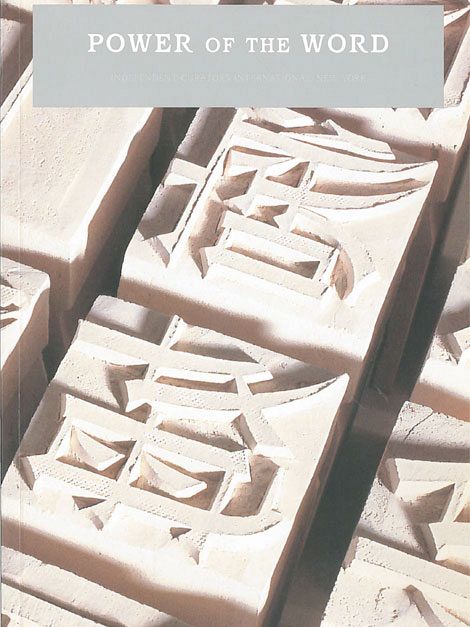
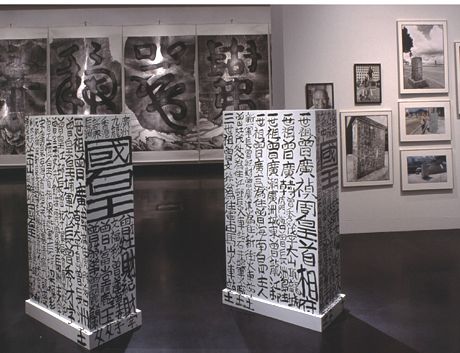
Joseph Kosuth claimed that each work of art is an analytic proposition; a sentence or claim about art. In Chinese calligraphy, each word is represented by its own unique symbol. Each word, then, has its own form; its own aesthetic. Where Kosuth has an art work representing a certain idea or concept, Chinese calligraphy has a symbol representing a single word, which may very well be an idea or concept itself. The comparisons between the ancient art of Chinese calligraphy and post-modern and contemporary art ARE fruitful and endless. In Power of the Word, curator Tsong-zung Chang uses the archaic art to explore contemporary issues in philosophy, art, and culture.
Essays by: Tsong-zung Chang and Robert Lord
Featured artists: Xu Bing, Fung Ming Chip, King of Kowloon, Wu Shanzhuan, Hung Tung, Gu Wenda, Mao Zedong, Qiu Zhijie, Wang Yong-ming
Chang, Tsong-zung, Power of the Word, Independent Curators International (ICI), New York, 2001. 56 Pages. 9.8 x 6.9 inches. Softcover. ISBN 091636562X.
__2001.jpg?w=1600)