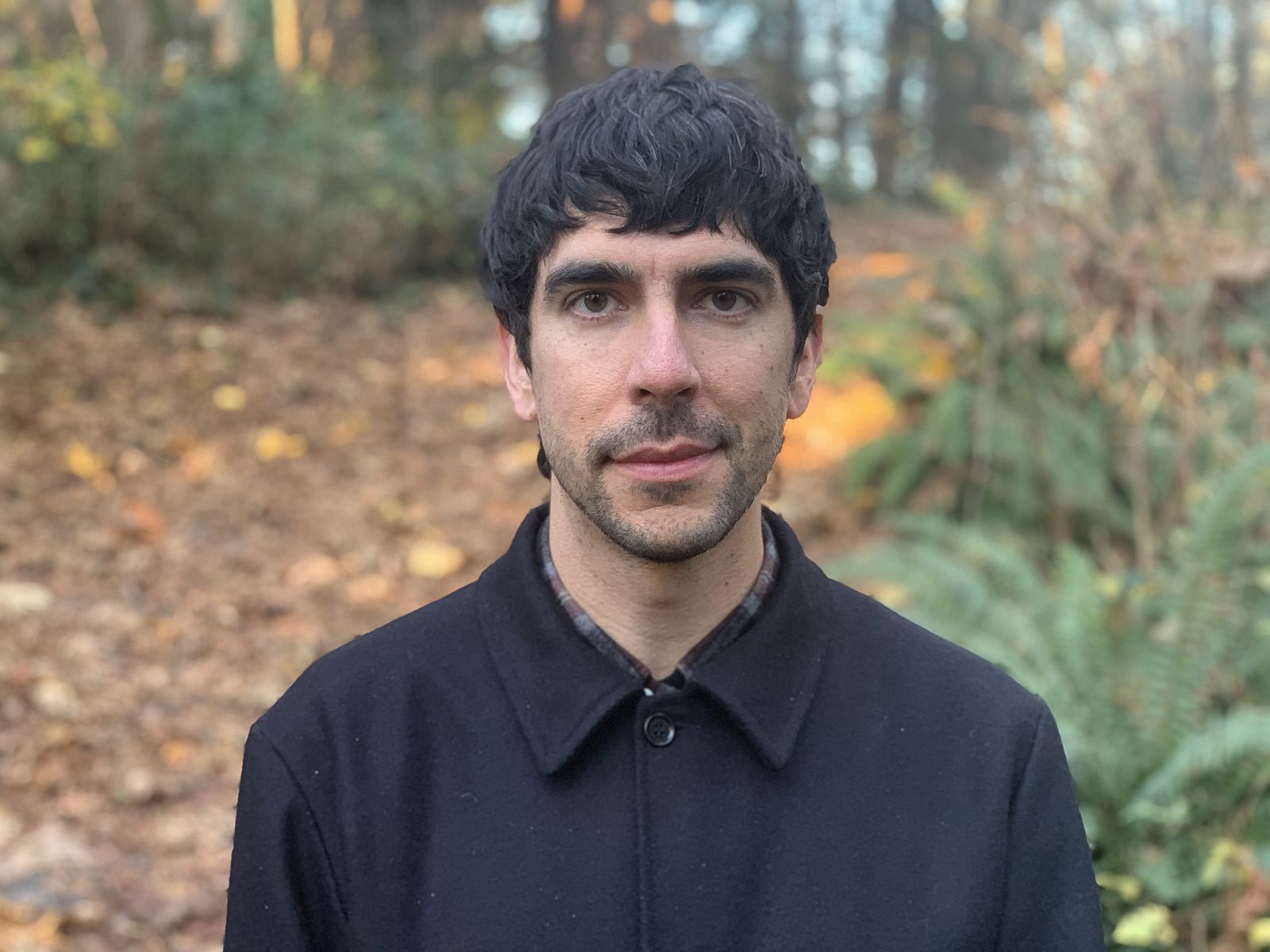
Curator Juaniko Moreno developed this proposal for the 2026 Curatorial Intensive in Montevideo, Uruguay.
Legal Borderline [Legal Limítrofe] is a research project that brings together artists and works whose conception, materiality, methodology, and/or execution test the legal limits of the context in which they are presented.
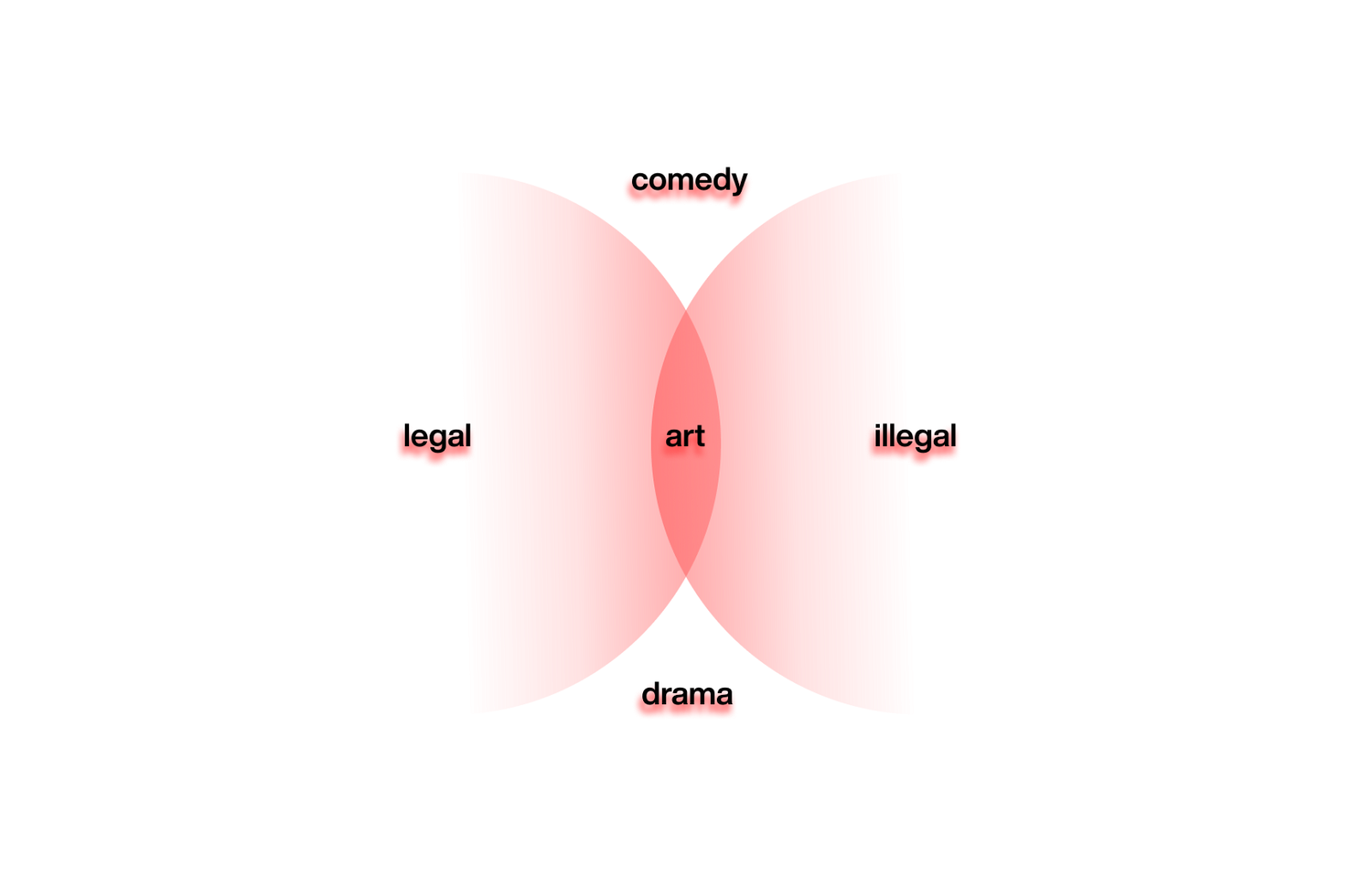
The project explores art that operates at the intersection of the legally allowed and socially accepted, in the grey area of informality that characterizes most of the Latin American context. By pointing to the limit, it calls into question the legal framework that governs us and serves as a starting point for speculating about other models, rules, or frameworks for legality. Highlighting where the borderline is traced in each context directly confronts taboos, restrictions, comfort zones, and collective imaginaries.
While gathering scholarship and examples from across the American continent, the project is inherently site-specific. Every exhibition context in which it takes place imposes regulations at the city and country levels, building regulations, sponsors' financial constraints, and a long list of overlapping legal frameworks. Consequently, with each limit it calls into question, the project interrogates the different dimensions of public space use, civil activity, freedom of expression, representation in cultural spaces, arts funding, commercial activity, and other dimensions in which artists from different contexts operate.
This project is conceptually related to American institutional critique, a movement with a critical focus on the cultural and philanthropic models of the Global North that are radically different from those in Latin America. What does institutional critique mean, then, in a context where institutions are, by their very nature, precarious? If institutions themselves do not represent figures of power, what does it mean to challenge their rules? What connotations does it carry to invoke the grey zones of illegality in a context so deeply marked and shaped by it?
From the social provocations of Tania Bruguera (Tatlin's Whisper, 2008–2015) to the challenges to art conservation raised by works with organic materials such as those of Teresa Margolles (Flag I, 2009) or Wilson Díaz; from Coco Fusco's mockery of the institutional image of museums in The Couple in the Cage (1993), to the challenges to gallery integrity in Rosemberg Sandoval; from Yoshua Okón's or Cildo Meireles's subversion of cultural funding systems to Minerva Cuevas’ hijacking of markets and credibility systems with Mejor Vida Corp (1999-), and so on — a large part of contemporary Latin American art operates at the limit of what is permitted and desired, engaging that boundary not as an exercise in stubbornness, but as a fundamental conviction of creation.
The legal and the socially agreed-upon are elements in constant negotiation and revision. Therefore, the reexamination of historical works, the recontextualization of installations, and the production of new works are key, as they open a dialogue with what is permitted, relevant, and desirable across different generations.
The project also oscillates between drama and comedy, parody and rule: challenging institutions typically involves sarcastic and defiant artists. Mockery is one of the first steps toward pointing at the absurd, and thus toward imagining new frameworks for negotiation and collective representation. By challenging, blurring, and dislodging norms, this exhibition points toward ways of making art that continue to operate within the bounds of what is permitted, yet still challenge an increasingly polarized, politicized, radicalized, and morally constrained social and cultural context.
Explore
Learning
Nov 1, 2020 – Feb 1, 2022